
Review · BELGIUM
From LIlle or Bruges, Christmas Truce to Passchendaele Ypres 1 day WW1 private
The most moving part of this private Ypres tour is how much ground you cover in one day. You follow the Australian advance from Messines and Hill 60 through Polygon Wood and Passchendaele, then finish among the graves, names, and trenches that make the Ypres Salient so powerful.
I like the personal route planning. Søren can shape the day around your family connection or special interest, and his explanations bring small sites to life. I also like the easy pickup from Bruges, Lille, Ghent, Arras, and nearby towns. The main drawback is the pace: nine hours and eight major stops make this a full day, with limited time for long walks or quiet reflection at each place.
Key points to know before booking
- Follow the Australian advance: The route links Messines Ridge, Polygon Wood, Hill 60, and Passchendaele rather than treating each site as an isolated stop.
- Hear the Christmas Truce story: Messines includes mine craters, the location connected with the 1914 Christmas Truce, and a crypt where Adolf Hitler was treated for wounds.
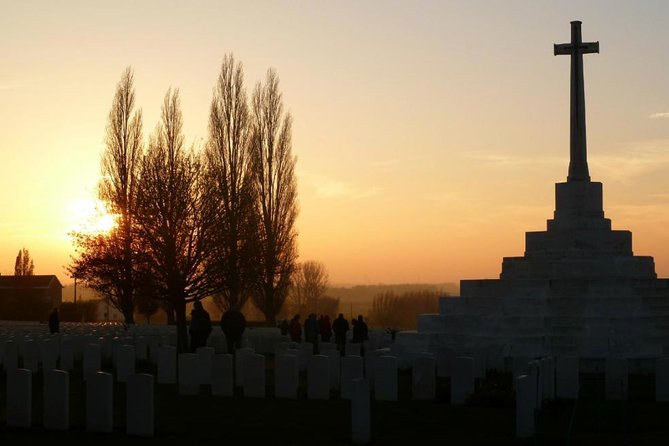
- Visit Tyne Cot Cemetery: About 12,000 Commonwealth servicemen are buried here, making it one of the day’s most powerful stops.
- Meet the guide, not a crowd: This is a private outing for your group, led by Søren, with room for questions and family-history research.
- See original trenches: Sanctuary Wood Museum contains unusual surviving First World War trench remains.
- Plan your lunch: Food is not included, though bottled water is provided.
Why this route gives you the full Ypres picture
The Ypres Salient is not one battlefield with a single viewpoint. It is a wide patch of Belgian countryside, towns, woods, cemeteries, roads, and ridges where battles shifted over several years. That makes a private vehicle tour especially useful. You can connect the places on a map without spending the day figuring out local transport.
This nine-hour trip covers the fighting around Messines, the 1917 Australian attacks, the cemetery system, the poetry of John McCrae, and the remembrance ceremony at Menin Gate. The route has a clear Australian focus, but it also explains the wider British Commonwealth effort.
Søren is the guide named for this experience. His role matters here because many of the sites are quiet and easy to miss. A grass-covered crater, a line of concrete bunkers, or a cemetery plot can seem simple until someone explains what happened there and why the place still matters.
The private format is another real advantage. You are not tied to a large group’s questions or pace. If your family has a connection to an Australian unit, a particular regiment, or a soldier buried in the area, you can ask for the route to reflect that interest. The day is still structured, but it has room for personal questions.
More Private Christmas Tours in the world:
- New York City Christmas Lights Private Horse Carriage Ride
★ 4.5 · 237 reviews - Christmas Lights Tour of Madrid in Eco Tuk Tuk Private
★ 5.0 · 125 reviews - Christmas in New York: Private Holiday History Tour
★ 5.0 · 107 reviews
Messines Ridge and the Christmas Truce
Messines Ridge gets about two hours, the longest stop of the day. That is sensible. The area brings together several stories that help you understand why the ground mattered.
You will hear about the Battle of Messines and see the mine craters left by the underground explosions. These craters are not just dramatic scars in the ground. They help explain the scale and method of the 1917 assault, when tunnelling and mines played a major part in the attack.
The site also connects with the Christmas Truce. That story can easily become sentimental if told without context, but here it sits within a larger account of the fighting around Messines. You can ask Søren about the difference between the popular image of the truce and the wider wartime setting.
Another unusual stop here is the crypt where Adolf Hitler was treated for wounds. It is a grimly memorable detail, linking this corner of the front to a later chapter of European history. The crypt is not presented as a separate historical tour, so your guide’s explanation will help place it in context.
Messines is a good opening because you begin with terrain and military planning before moving into cemeteries and personal stories. Wear shoes that can handle uneven ground. The tour includes outdoor sites, and the schedule does not leave space for changing footwear during the day.
Hooge Crater Cemetery and the Menin Road
Hooge Crater Cemetery is a short stop of about 15 minutes, but it carries several precise links to the 1917 fighting. You will visit the grave of Pat Bugden VC, a 20-year-old Australian recipient of the Victoria Cross.
That detail gives the cemetery a human scale. Instead of hearing only about units and dates, you are directed to one young soldier and the action that earned him Britain’s highest award for gallantry.
You will also be beside the Menin Road, close to the former Australian gun pits used during the assault on Passchendaele. The road was important because troops and supplies moved along it, making it a natural focus for artillery and attack planning.
Fifteen minutes is enough for an explanation and a focused look, not a long cemetery visit. If you want more time at individual graves, tell Søren early in the day. The private format makes such adjustments more possible, though the full route means another stop may need to be shortened.
Polygon Wood, bunkers, and the Australian Fifth Division
The next stop covers Polygon Wood in about 30 minutes. You will walk through the woods, see concrete bunkers left from the fighting, visit the cemetery, and stop at the Australian 5th Division monument.
This is one of the places where the battlefield can feel deceptively calm. Trees and open ground do not immediately reveal the violence of the 1917 battles. The bunkers provide a physical reminder that soldiers fought from fortified positions and that the remains of those positions can still be found among the trees.
The Australian monument adds another layer. It connects the place to the men who fought here, rather than leaving the story at the level of generals and maps.
The tour also points out an Australian headquarters location from September 1917 and discusses earlier action on the same ground in November 1914. That time span matters. The same patch of earth could be used, lost, and attacked again as the front shifted.
This stop suits anyone who wants battlefield detail rather than only memorial visits. It does involve walking, but the listed time is fairly short. You will get a guided introduction rather than an extended woodland hike.
More festive day trips from the world:
- Auckland: Hobbiton Movie Set Day Trip with Festive Lunch
★ 4.8 · 1,431 reviews - London Christmas Day 1 Day Hop-on Hop-off Bus Tour
★ 4.0 · 15 reviews - One day tour Christmas markets Innsbruck – Bressanone – Vipiteno
★ 4.5 · 11 reviews - From London: Christmas Day Trip to Windsor, Oxford & Avebury
★ 3.7 · 3 reviews
Hill 60 and the mine exploded at 3:10 a.m.
Hill 60 receives about 45 minutes and is one of the day’s strongest military-history stops. Here you will hear about Captain Woodward and the 1st Australian Tunnelling Company, who placed a huge mine beneath the position.
The mine was exploded at 3:10 a.m. on June 7, 1917. Seeing the crater gives the story a physical anchor. Dates and times can feel abstract in a book, but a crater shows the force involved and the effort required to prepare the attack underground.
Hill 60 also helps explain why high ground mattered in the Ypres area. Even a modest rise could offer observation and firing advantages. That is why places that look small on a modern map could become fiercely contested.
I appreciate that the stop focuses on the tunnelers as well as the troops above ground. Their work was slow, dangerous, and largely hidden. It also gives you a different view of the war, one based on engineering, noise, darkness, and timing rather than only infantry movement.
After Hill 60, you drive along the line of the Australian advance. That drive is useful because it connects the separate sites. You are not simply jumping from one attraction to the next. You are tracing a direction across the battlefield.
Tyne Cot Cemetery and the scale of loss
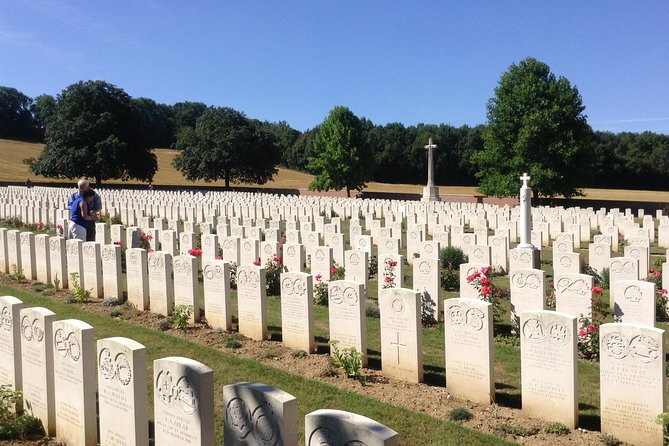
Tyne Cot Cemetery gets about 45 minutes. It is described as the world’s largest Commonwealth War Graves Commission cemetery, with about 12,000 soldiers buried there. Only around 3,000 of those buried have identified names, according to the tour information.
The numbers are difficult to absorb, which is why the layout matters. Rows of graves and the memorial names make the scale visible without requiring dramatic presentation. The setting asks for quiet attention.
Two Australian recipients of the Victoria Cross are buried at Tyne Cot. Their graves provide another specific link to the Australian story running through the day.
Do not expect to understand the entire cemetery in one visit. Forty-five minutes gives you time to walk, listen, and locate the places your guide highlights. It is enough for a meaningful stop, but not enough to read every inscription or search every name.
This is also a good place to bring a family surname or service number if you have one. The tour can be tailored for family connections, but you should share those details when booking or before the day begins so Søren can plan appropriately.
John McCrae’s hospital site and the human voice of war
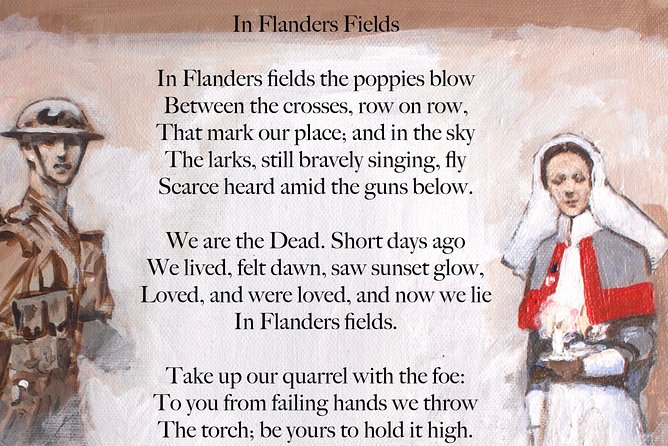
The John McCrae site receives about 30 minutes. This is the hospital location where Lieutenant Colonel John McCrae composed In Flanders Fields.
The poem is familiar, but seeing the place connected with its writing changes how it lands. McCrae was not writing from a distant study. The poem came from a wartime medical setting, close to the wounded and the dead.
This stop gives the day a different tone. At Messines, Hill 60, and Polygon Wood, the focus is on mines, trenches, roads, and attacks. Here, the focus shifts to memory and language.
You do not need to be a poetry specialist to value the visit. If you know the poem well, the site adds context. If you do not, the stop still helps explain why the poppy became such a lasting symbol of remembrance.
Menin Gate and the 55,000 missing
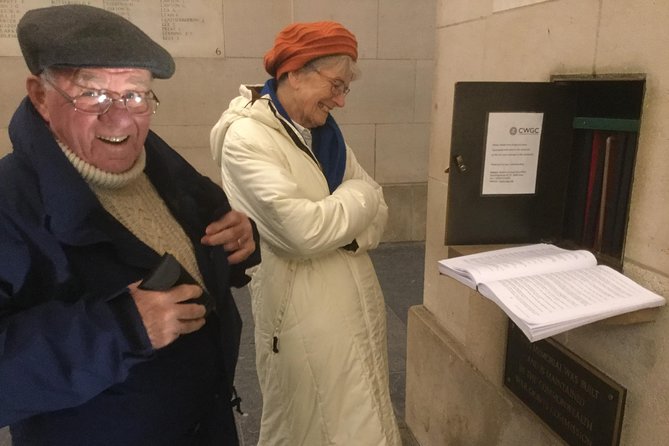
Menin Gate Memorial is a 20-minute stop. You will hear how the memorial came about and learn about the roughly 55,000 names of missing servicemen recorded there.
The scale is again immense, but the gate gives it an urban setting. Unlike a cemetery surrounded by open ground, this memorial is part of Ypres itself. Daily life moves around it, while the names remain fixed in the walls.
The tour can also help you understand why Menin Gate is central to Ypres remembrance. It is not simply a grand entrance or an architectural landmark. It is a record for men whose bodies were never identified or recovered.
If your schedule allows, ask about staying for the Last Post ceremony. One person who took this tour specifically noted that it may be possible to remain for the ceremony, but it is not listed as a guaranteed part of the nine-hour outing. Treat it as a possible addition, not a promise.
The 20-minute visit is enough for the main explanation, but the memorial deserves patience. If you are most interested in names, family research, or the ceremony, that may be the point where you want to spend extra time.
Sanctuary Wood and surviving trenches
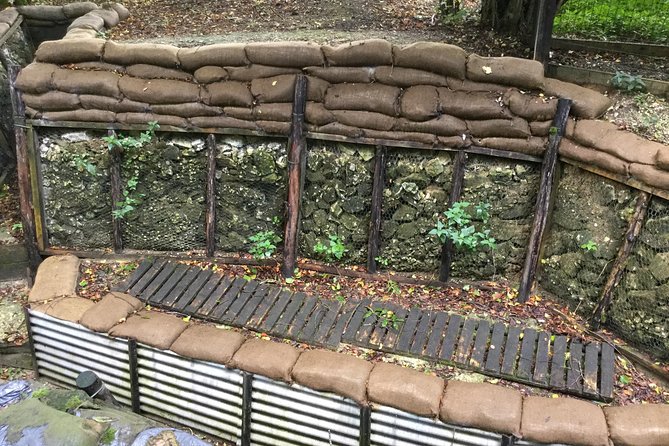
Sanctuary Wood Museum is the final listed stop, with about 40 minutes. Its main draw is a set of original First World War trenches.
This is one of the most tangible parts of the day. A cemetery asks you to imagine the people behind the names. A trench shows the cramped defensive world in which soldiers lived and fought.
The museum is included in the tour, unlike the other listed stops, which have no separate admission charge. That keeps the day simple, though lunch is not included and should be planned with Søren.
Because Sanctuary Wood comes late, you may be tired by the time you arrive. That is worth considering. The stop is still valuable, but you may not have the same energy you had at Messines in the morning. If trenches are your main interest, mention that when arranging the tour.
What the price buys you
The listed price is $532.32 per person. That is a serious cost, but this is also a private nine-hour outing with pickup and drop-off from a wide area. The value improves if you are sharing the vehicle with family or friends, especially if you would otherwise need to arrange several trains, taxis, or local tours.
You are paying for more than admission. Most listed stops have no admission charge, so the main value is Søren’s time, route planning, transport, battlefield interpretation, and the ability to adjust the day to your interests.
The price is harder to justify if you only want a quick look at Ypres itself or have no interest in First World War sites. It makes more sense if you want a full battlefield day, have Australian family connections, or prefer a private guide to a fixed group itinerary.
Hotel and bed-and-breakfast pickup is offered within a 66-kilometre radius of Ypres. The pickup area includes Bruges, Lille, Arras, and Ghent Dampoort Station as the Ghent meeting point. Confirm your exact address before booking, since the wide service area is one of the tour’s practical strengths.
Pace, walking, lunch, and the practical details
The day begins at 9:00 a.m. and lasts about nine hours. The itinerary includes several short stops, driving between sites, and walks at cemeteries, woods, trenches, and memorials. Most people can participate, and service animals are allowed.
Bring comfortable shoes, weather protection, and water. Bottled water is provided, but lunch is not. Since the schedule is full, ask how and when lunch will be handled rather than assuming you can stop wherever you like.
The tour is offered in English. Confirmation is sent within 48 hours of booking, subject to availability. Free cancellation is available until 24 hours before the start time. Changes or cancellations inside that window are not accepted for a refund.
Who will get the most from this day
I would choose this tour if you want the battlefield explained as a connected story. It is especially well suited to people with Australian military interests, family records tied to the Ypres area, or a serious interest in the First World War.
It also works well for a small family group that wants a private pace and hotel pickup. You can ask questions without waiting for a large group to move on, and Søren can give extra attention to the details that matter to you.
I would hesitate if you want a relaxed sightseeing day with long café breaks. The schedule is packed, and the subject is emotionally heavy. You will see cemeteries, graves, memorial names, trenches, and sites connected with mass violence. That is the point of the trip, but it is not light entertainment.
Should you book this Ypres battlefield tour?
Book it if you want depth, a private guide, and a route that links Messines, Hill 60, Polygon Wood, Passchendaele, Tyne Cot, McCrae, Menin Gate, and Sanctuary Wood in one day. Søren’s passion, clear explanations, and willingness to shape the route around family history are the strongest reasons to choose it.
Skip it if your main goal is a short visit to Ypres, or if you prefer to move slowly at one or two cemeteries. For everyone else, the high price buys a practical, focused way to understand a large battlefield that would be difficult to piece together alone.
FAQ
Where does the tour start?
The tour starts at 9:00 a.m. Pickup is offered from hotels and bed-and-breakfasts within a 66-kilometre radius of Ypres.
Can I be picked up in Bruges?
Yes. Hotel pickup is offered from Bruges.
Is pickup available from Lille?
Yes. Lille is included in the pickup area.
Can I join from Ghent?
Yes. The listed Ghent pickup point is Ghent Dampoort Station.
Is pickup available from Arras?
Yes. Pickup is offered from Arras.
How long does the tour last?
The experience lasts about nine hours.
Is this a private tour?
Yes. Only your group participates in the activity.
Is the tour offered in English?
Yes. The tour is offered in English.
Is lunch included?
No. Lunch is not included. Bottled water is provided.
Can the tour be adapted for family history?
Yes. The route can be tailored if you have family history tied to the region.
Is admission to Sanctuary Wood included?
Yes. Admission to Sanctuary Wood Museum is included.
New this season in the world
- Private New York City Christmas Walking Tour★ 3.5 · 5 reviews
- New York Christmas Holiday Lights Walking Tour★ 5.0 · 8 reviews
- New York City Christmas Holiday Lights Sightseeing Cruise★ 5.0 · 4 reviews
- NYC: Dyker Heights Christmas Lights Express from Times Square★ 5.0 · 2 reviews
- Ultimate NYC Christmas Lights At Night Walking Tour★ 5.0 · 2 reviews
- NYC: Dyker Heights Christmas Lights Express Hot Coco+Santa Cookie★ 3.0 · 4 reviews
- Private Christmas Lights Horse Carriage Tour In New York City★ 5.0 · 2 reviews
- Christmas Lights Tour of Dyker Heights Brooklyn★ 3.5 · 4 reviews
Belgium Christmas Tours, side by side.
From Ypres, The Christmas Truce to Passchendaele Ypres Based WW1 private tour
Read our review →
Brussels Private & Personalized Christmas Tour with a Local Guide
Read our review →
From Ypres 4hr Christmas Truce and Monster Mines of Messines PRIVATE Tour
Read our review →
Brussels: Christmas Market Magic Walking Tour with a Local
Read our review →
Discover the magic of Christmas in Brussels with a local guide
Read our review →
Christmas Magic in Bruges – Private Walking Tour
Read our review →
This tour also sits in